.svg)
.svg)
Identifying circularity opportunities for data centres at unparalleled speeds
.png)

Identifying circularity opportunities for data centres at unparalleled speeds
Proven results

From data entry to real decarbonisation insights that you can act on immediately
Uncertainty reduction in one week hinging on a few data points
More product footprints for requesting customers than one standard ISO LCAs
Emissions reduction potential from circularity, reuse and recycled materials
The perfect dataset does not exist. Acting with enough data is the key. Focus on the data that unlocks impact. Watch your data quality at all times. Track reductions and show progress to your customers.
The Challenge
NetApp sells intelligent data infrastructure—combining storage systems, data management software, and cloud services—to help customers run, protect, and move data seamlessly across onpremises and cloud environments used by organisations worldwide. Unlike a consumer product with a fixed specification, NetApp designs equipment with customer needs at the forefront. NetApp’s hardware is inherently configurable, with each customer deployment—and even within the server rack—customized based on regional requirements, customer use cases, and evolving product generations. This variability limits the effectiveness of static or longcycle carbon footprinting and necessitatesnear realtime decarbonisation signals to inform product and configuration decisions in order to achieve NetApp’s 2030 Science Based Targets.
NetApp’s customers are signalling the need to provide credible product carbon footprints (PCFs) in a market where competitors already had ISO-compliant life-cycle assessments (LCAs) for their products. Producing a comparable PCF for a single representative configuration was achievable, but that approach carried fundamental weaknesses: a PCF for one build of one server is not representative of the hundreds of configurations that NetApp actually ships; and conducting their own life-cycle assessment each time to stay competitive would take too long and would not reflect the variability of their portfolio. NetApp needed a tool that could provide credibility and steer quantifiable actions at speed to actually drive decarbonisation at scale.
The Process
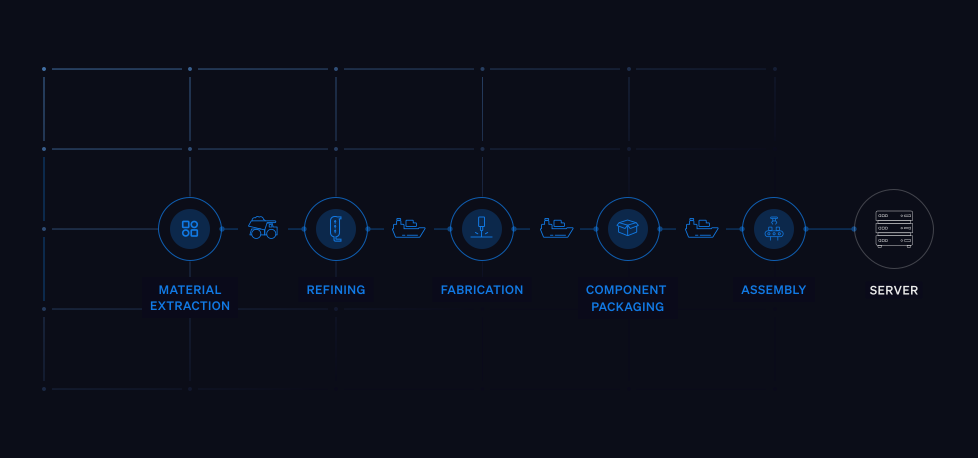
The deeper value emerged from how Neutreeno modelled the product portfolio as a whole. Rather than treating each server configuration as an independent analysis requiring its own data set, the system used the initial bill of materials to build a set of modular building blocks: the core components and sub-assemblies that recur across configurations, each carrying its own uncertainty-bounded PCF. From this foundation, new configurations can be assembled rapidly, drawing on existing modelling work rather than starting from scratch.
How Neutreeno Helped
Neutreeno's engagement with NetApp demonstrated a principle that sits at the heart of how the system is designed: you do not need perfect data to start. From the moment NetApp submitted their first data, the clock started. Within 9 days, Neutreeno had returned a first-pass PCF with clearly quantified uncertainty bounds, accompanied by specific actions the team could take immediately based on what the analysis already showed.
The Neutreeno system ingested a bill of materials that NetApp had on hand. It focused on the important data, highlighting structured assumptions and quantifying the resulting uncertainty for every component in the analysis. This produced a meaningful range of emissions values. Crucially, it also explicitly flagged where the largest uncertainties were, so the team knew precisely where additional data collection would have the greatest impact on result quality. There is always a clear next step. All this was done without needing to do an LCA that forensically pursued every single data point: rapid results built on scientific rigour.
From this, Neutreeno identified three additional data points on the SSD component that reduced overall uncertainty in the results by 650%.
The deeper value emerged from how Neutreeno modelled the product portfolio as a whole. Rather than treating each server configuration as an independent analysis requiring its own data set, the system used the initial bill of materials to build a set of modular building blocks: the core components and sub-assemblies that recur across configurations, each carrying its own uncertainty-bounded PCF. From this foundation, new configurations can be assembled rapidly, drawing on existing modelling work rather than starting from scratch.
For NetApp, customer requests for PCFs at a regionalconfiguration level were historically out of reach, and when possible, required months of intensive analysis. The building blocks to support these request are already in the system and can be generated at will by sustainability teams. This is critical given how many requests teams are getting. The assumptions have already been validated. What would otherwise require a dedicated LCA practitioner for months, with Neutreeno, was turned around 60 times faster.
"For years, the industry has been chasing the perfect data set–spoiler alert – it doesn't exist. As Scope 3 practitioners, we’re getting better at collecting more real data, but the reality is that what sits behind that data is constantly changing across globally interconnected supply chains. Working with Neutreeno helped us reframe the problem. Instead of waiting for perfection, Neutreeno showed us what’s possible with the data we already have—and how even small, targeted improvements can dramatically reduce uncertainty. That shift unlocked a much clearer path to where decarbonisation actions actually matter most."

Key Results
Within 9 days of receiving initial product data, NetApp had a first-pass PCF accompanied by specific, prioritised actions, 60 times faster than what an 18-month LCA would have provided. NetApp’s outcomes were inherently dynamic, with each action generating measurable impact that increased confidence and informed ongoing improvements.
The analysis modelled the full variation of NetApp's server configurations, giving the team a flexible, reusable foundation for customer-specific PCF requests and future design decisions. Circularity scenarios, including take-back and recycled content pathways, were quantified within the same framework, providing a clear picture of the emissions reductions available to the business today alongside a roadmap for further improvement. Additional statistical data including forecasted cost of carbon and quantified reduction potential will be confirmed as the engagement continues.
Neutreeno's system quantified the emissions impact of circularity interventions within the same analytical framework as the product PCF itself, so the relationship between design choices, material flows, and emissions outcomes was visible in a single coherent picture.
The core finding was that imperfect data does not mean imperfect action. From day 9 onwards, NetApp had something most of their competitors do not: a live, uncertainty-aware model of their product emissions that updates as the business does.
Download this case study
See how others solved it
Real companies, real problems, real results. Explore the use cases that match your challenge.

Unlocked sustainable product design

Unlocked sustainable product design
