.svg)
.svg)
Transforming Aerospace Manufacturing with Data-Driven Decarbonisation


Transforming Aerospace Manufacturing with Data-Driven Decarbonisation
Proven results

Annual cost savings identified through process optimisation
Total emissions reduction from a single production method change
Improvement in energy efficiency from switching blade-cutting approach
Waste reduced by improving process efficiency
Decarbonising and reducing costs are not a trade-off. Map your resource flows. Find the hidden inefficiencies. Change how it's made.
The Challenge
AeroEdge manufactures high-precision fan blades for aircraft engines — components where tolerances are measured in microns and material performance is non-negotiable. As a supplier operating within global aerospace value chains, AeroEdge faces mounting pressure to demonstrate credible progress on emissions and resource efficiency without compromising on the precision and reliability its customers demand.
Manufacturing processes at this level of complexity generate significant emissions and energy consumption, but the relationship between specific process choices and their downstream environmental and cost impact is rarely visible. Standard carbon accounting approaches treat manufacturing as a black box: they capture what goes in and what comes out, but not the process decisions in between. For a company whose competitive edge is defined by how it makes things, that invisibility was the core problem. AeroEdge needed a system that could see inside the process — and identify where change was both possible and impactful.
The Process
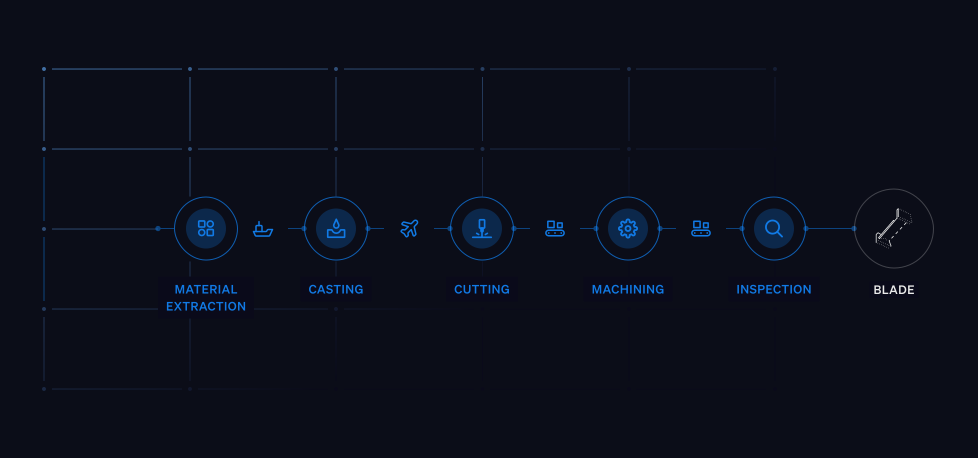
Neutreeno ingested AeroEdge's manufacturing data and built a process network model of the blade production operation. The system quantified resource flows and uncertainty at each node, surfacing where imprecise data was driving imprecise results — and where additional data points would deliver the greatest improvement in confidence.
From this model, Neutreeno identified the blade-cutting stage as the primary lever. The analysis compared the current production method against a more energy-efficient alternative, modelling the emissions, energy, and material implications of the switch across the full production process. The output was a prioritised, quantified case for a specific operational change — not a set of recommendations requiring further study before action could begin.
The findings were designed to travel inside the business. The analysis could be presented to engineering, procurement, and leadership teams at different levels of technical depth, with the underlying model available for interrogation rather than a static report to be accepted or questioned without recourse.
How Neutreeno Helped
Neutreeno mapped AeroEdge's production processes at the level where decisions actually get made. Rather than working from aggregated emissions factors or industry averages, the system modelled the specific resource flows and energy inputs associated with AeroEdge's manufacturing operations, quantifying uncertainties at each stage and identifying where the greatest leverage lay.
Within 21 days, Neutreeno had returned a clear finding: a more efficient approach to blade-cutting offered a materially different emissions and cost profile. The analysis did not require a comprehensive life-cycle assessment or months of data collection. It required the right model applied to the data AeroEdge already had.
The insight was process-level, not reporting-level. Neutreeno identified a specific production method swap — not a supplier engagement programme, not an offset strategy — that changed the economics and the emissions of the manufacturing operation in the same move. Energy consumption dropped. Material waste fell. The cost base improved. The emissions reduction followed directly from the operational change, not from an accounting adjustment.
"Neutreeno's system has enabled us to map our highly complex resource flows, quantify data uncertainties and identify supply chain and manufacturing process swaps, leading to increased material efficiency and significant cost reductions."

Key Results
Within 21 days of beginning the engagement, AeroEdge had a clear, actionable finding: switching to a more efficient blade-cutting method would reduce total emissions by 41.4%, improve energy efficiency by 80.5%, and deliver €1.6M in annual cost savings.
Each of those outcomes is a consequence of the same operational decision. That is the core value of process-level analysis: when you understand how something is made, the levers for improvement become visible — and the case for acting on them becomes straightforward to build.
For AeroEdge, Neutreeno did not produce a carbon report. It produced a direction.
Download this case study
See how others solved it
Real companies, real problems, real results. Explore the use cases that match your challenge.

Unlocked sustainable product design

Gained insights 60x faster
